Does Foot Massager help with osteoarthritis? Let’s revisit this question from a long-term management perspective.

Does a foot massager have any benefits for osteoarthritis?
This question seems simple on the surface, but it’s actually not easy to answer.
On the one hand, many osteoarthritis patients do feel “more comfortable” after using
Foot Massager products; on the other hand, the medical community repeatedly emphasizes that osteoarthritis is a structural degenerative disease that cannot be reversed by massage.
Thus, a conflict arose.
This article does not attempt to provide a black-and-white answer but rather re-examines the true role of foot massagers in osteoarthritis from the perspectives of long-term management, real-world user experience, and medical consensus.
Why do osteoarthritis patients focus their attention on their “feet”?
Many people who are new to osteoarthritis focus entirely on the painful joints, such as the knee or ankle.
However, in real life, problems are often not so localized.
As the disease progresses, osteoarthritis patients often experience:
- Gait changes
- Compensatory muscle tension in the lower limbs
- Abnormal plantar pressure distribution
- Fatigue appeared significantly earlier after walking.
These changes will ultimately be reflected in your feet.
The feet are the outermost part of the body that bears weight and transmits force.
When problems occur in the upstream joints, the feet are often the first to bear the consequences.
This is why many people, after trying various methods, eventually start to focus on foot relaxation and foot care.
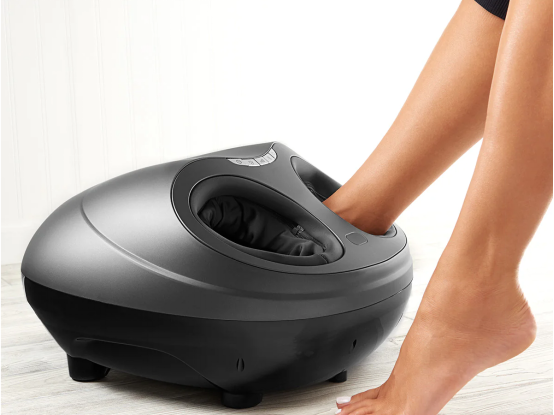
II. In principle, what exactly does Foot Massager “intervene” in?
It is important to define a boundary before discussing the effects.
The primary target of a foot massager is not the joint itself, but rather the environment surrounding the joint.
Specifically, it mainly affects:
- Foot muscle and fascia condition
- Lower extremity blood circulation efficiency
- The nervous system’s sensitivity to pain
- Recovery rhythm after prolonged weight-bearing
This is why you often see doctors using words like “assist,” “support,” and “relief” when talking about these kinds of products.
It doesn’t change the structure on an X-ray, but it can change how you feel throughout the day.
III. In what ways does Foot Massager actually help with osteoarthritis?
1. Pain is relieved, but not in a way that “disappears immediately.”
Many users expect a very clear change when they use it for the first time, such as “the pain will stop after pressing.”
Reality is often more lenient.
A more common experience is
- Pain intensity decreased
- The discomfort appeared later
- Pain duration shortened
From a neuromodulation perspective, moderate mechanical stimulation can indeed affect the way pain signals are transmitted, a point that is not unfamiliar in chronic pain management.
2. The improvement in stiffness is more noticeable than the pain itself.
For many osteoarthritis patients, the real problem is not the pain but the inability to move.
Especially:
- Wake up in the morning
- Stand up after sitting for a long time
- When the weather changes
Regular use of the Foot Massager makes it easier to feel the difference at these times.
The reason is simple: improved circulation and soft tissue relaxation make it easier for the body to “start up.”
3. The impact of relaxing the feet on the knee joint is often underestimated.
This is a chain that is easily overlooked.
When the soles of the feet are under prolonged tension or abnormal stress, the stability of the knee joint can be affected.
Once the knee joint becomes unstable, the pain often worsens.
Improving lower limb alignment indirectly through foot relaxation is not an immediate solution, but it is valuable in long-term management.
4. The impact on the pace of life is often more real than the data suggests.
This point is not often emphasized in medical papers, but it is repeatedly mentioned among real users.
Many people would say:
- “I’m not so resistant to going out for a walk anymore.”
- “It’s easier to fall asleep at night.”
- “I’m not as tense as before.”
These changes are not exaggerated, but they are very real.
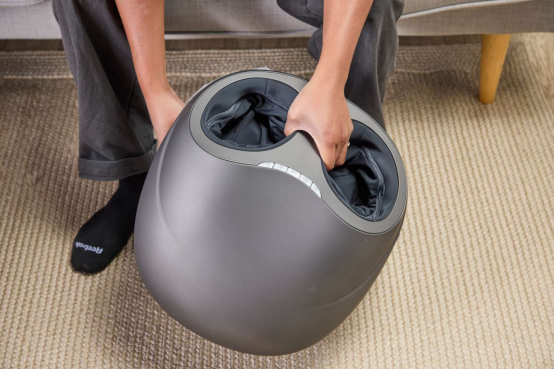
IV. Which people with osteoarthritis are more likely to benefit from this?
It’s not suitable for everyone, and the effects are not the same at all stages.
Generally speaking, the more suitable ones include
- Mild to moderate osteoarthritis
- The pain is mainly of the fatigue and stiffness type.
- People with still high daily activity levels
- Users who want to reduce drug dependence
If the structure has already entered a stage of severe damage, the expected outcome needs to be lowered.
5. Three issues that are most easily overlooked when using Foot Massager
1. Greater strength is not necessarily better.
Joint-friendly stimulation is usually gentle and continuous.
2. With occasional use, it’s difficult to judge the effect.
Truly valuable feedback often comes from consistent use over 2–4 weeks.
3. It cannot replace overall management.
Weight management, activity level adjustments, and doctor follow-ups remain essential.
VI. How to integrate Foot Massager into the daily management of osteoarthritis?
A more realistic approach is to treat it as part of your daily routine, rather than as a “therapeutic tool.”
For example:
- Use it to relax in the evening
- After a day with high activity levels
- When the weather changes and stiffness becomes obvious
15–30 minutes at low to moderate intensity is actually easier to stick to.
FAQ: Frequently Asked Questions about Foot Massager and Osteoarthritis
Will a massager worsen osteoarthritis?
Generally, it will not if used properly without contraindications.
Is it safe to use daily?
Most people can, but it’s still advisable to pay attention to individual feelings.
Is a doctor’s consent required?
If the condition is complex or accompanied by other illnesses, it is safer to consult a doctor.
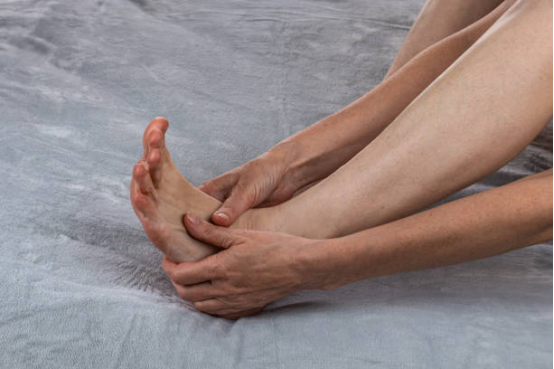
Summary: The true location of the Foot Massager in osteoarthritis
If I had to summarize it in one sentence:
A foot massager isn’t the answer to osteoarthritis, but it might make your daily life a little easier.
It is better suited to be placed in the long-term management toolbox than to be treated as the sole reliance.
If you’re considering it from the perspective of “improving comfort and reducing daily burden,” it’s a rational choice.